Sunday, June 12, 2005

Coffe and Cigarette

.
The fine, funky cool of Jim Jarmusch permeates this lyrically funny cluster of eleven stories that Jarmusch began filming in 1986. Sure, it's just two or three people bonding over the twin addictions of the title. But Jarmusch makes it a feast that plays like a haunting concept album. I liked some tracks more than others. Bill Murray is hilarious serving java to RZA and GZA; Cate Blanchett scores a tour de force playing herself and her black-sheep cousin; Tom Waits memorably encounters Iggy Pop. Best of all is a chat between Alfred Molina and Steve Coogan that slyly sticks it to Hollywood. Jarmusch is still the indie soul incarnate.

www.rollingstone.com

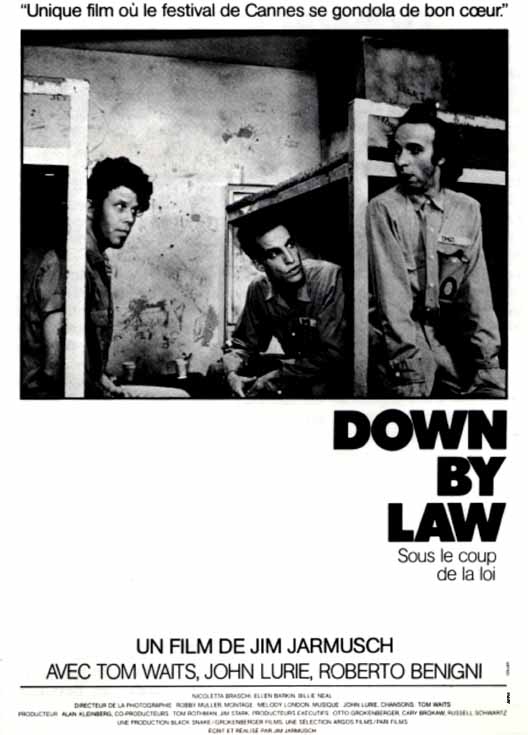
Down By Law

.
American independent director Jim Jarmusch leaped onto the world cinema stage with the idiosyncratic deadpan road movie Stranger than Paradise in 1984 and then followed it up with the equally distinctive prison break movie Down by Law in 1986.

Down by Law became an immediate cult hit partly because of its pokey humor style but also because it starred musicians Tom Waits and John Lurie along side upstart Italian comedian Roberto Benigni – who is so over-the-top he really revs up the film’s expressionless tempo.

As in many of Jarmusch’s films this one is a modern matter-of-fact fable about down-and-out guys who get caught in the wrong place at the wrong time. In this case the two main characters are Jack (Lurie), a small time pimp, and Zack (Waits), a DJ. Both of them – who don’t know each other until they end up in the same jail cell together – are set up and wrongfully arrested. The third character is an Italian tourist (Benigni) who ends up in the cell with them. They spend a few weeks in the cell and finally manage to escape into the swamps of Louisiana.

Down by Law, now available on DVD from The Criterion Collection, takes a while to really get going. Jarmusch establishes the gorgeous black and white look, the unhurried pace and vibe of Louisiana, as the primary focal point of the film. The story and the characters develop little by little, as does the humor.

Jarmusch’s humor is atypical in film history. He doesn’t rely on slapstick or zany screwball comedy. Instead he uses a deliberate, accumulative humor that can only be appreciated as the movie goes along. It’s a humor predicated on rigorous framing and long-held shots, which become funny by virtue of their awkward rhythm. Often the dull manner in which the characters talk to one another and the empty spaces they occupy becomes funny for no apparent reason.

This brand of humor – which isn’t to everyone’s taste – was used to some degree in the past by Buster Keaton and Jacques Tati. Today it is employed by such directors as Aki Kaurismaki (Leningrad Cowboys Go America) and Tsai Ming-Liang (What Time is it There?) but not as much in American cinema. In Down by Law the humor comes mainly in the second half when we realize – along with the characters – the absurdity of their situation in the swamps. Basically, they have escaped one prison for another. At least for a while – until the fable-like last 20 minutes.

Down by Law may not be Jarmusch’s best film since it tends to poke along a little too slowly at times. But it does have some great moments and it really picks up steam toward the end as the three try to escape the swamp. However, the Criterion Collection DVD of the film is by far the best DVD currently available for any Jarmusch film.

filmcritic.com

Stranger Than Paradise

.
Artistically if not economically, the '80s were awfully dismal times for Hollywood, which, after the restless experimentation of the previous decade, reverted to assembly-line moviemaking under the guidance of the Eisners and the Ovitzes and the Spielbergs. It's not surprising that one of the decade's true highlights is this beautifully loping piece of black-and-white minimalism.
Centering on the random escapades of a knockabout trio--Willie (John Lurie), his Hungarian cousin (Eszter Balint), and Willie's pal Eddie (Richard Edson)--STRANGER THAN PARADISE stands out from the plot-driven Hollywood product simply by daring to omit plot. The action, if you can call it that, scrolls from New York to Ohio to Florida (the film was entirely shot on location), but, perversely, nothing really happens. The movie plays out in a minor key--this is its strength. The film's laconic humor depends on the apparent pointlessness; each scene ends with a abrupt blackout, which only underscores, rather effectively, the apparent emptiness of the material. The film may or may not be making a broad comment on culture clash; it's hard to say. Just imagine a feature film composed of "deleted scenes" and you have a sense of the movie's aimless texture.

For this early effort, Jarmusch won the Camera d'Or (Best First Film) at Cannes. There is indeed something distinctly European about his style--introverted, laid-back, deriving more from the Theatre of the Absurd than from American sources. Or perhaps not: STRANGER reminds me of nothing more than the drifting feel of life in the Midwest (Jarmusch is from Ohio). It's difficult to depict banality on film; directors who try usually end by condescending to their subjects--think of Fargo, impressive though it is in many areas. Jarmusch does not. This alone makes STRANGER a major achievement.

Though clearly filmed on the cheap, the movie displays Jarmusch's sure hand at every turn--only one scene, a mistaken-identity bit toward the end, is clumsily staged.

A real charmer, it is--a minor masterpiece, and a rare bright spot from a generally undistinguished period

www.ecritic.com

Mystery Train

.
In the first episode, two teenage Japanese tourists -- the glum Jun (Masatoshi Nagase) and his bubbly girlfriend, Mitzuko (Youki Kudoh) -- train into Memphis to visit the shrine of their King, Elvis. Actually, Jun prefers Carl Perkins, but he gives Presley his royal due. After a long day on the hot streets and a fast visit to Sun Studio, Jun and Mitzuko check into the Arcade and make love under a garish portrait of Elvis (one comes with every room). Later, listening to the King croon "Blue Moon" on the radio, Jun gazes out the window at the neon-lit streets and distant train tracks. "This is cool," he tells Mitzuko, a cigarette dangling from his lips and Memphis at his feet. For a moment, with the help of Robby Mnller's evocative camera work (this is the first Jarmusch film shot in color), it is. By an act of will, two foreigners have made Memphis the exotic, hip Mecca they want it to be. Similarly, the Hungarian visitor in Jarmusch's Stranger Than Paradise and the Italian immigrant in Down by Law turned America into their best fantasies in a way most of us who live here cannot. Come morning, the spell broken by the sound of a gunshot down the hall, Jun and Mitzuko move on.


In the second episode, Jarmusch uses Luisa -- a young Italian widow beautifully played by Nicoletta Braschi -- to offer a fresh perspective on the familiar. Unlike the Japanese couple, Luisa is not on a pilgrimage. She has been forced to stop in Memphis overnight before flying her husband's body back to Rome. Elvis means little to her, though she is amused when a wacko in a coffee shop (an eerie Tom Noonan) announces that he recently picked up the dead King hitchhiking. It seems Elvis had a comb he wanted the driver to pass on to Luisa. She makes her getaway to the Arcade, where she lets herself be talked into sharing a room for the night with an American named DeeDee (Elizabeth Bracco) who can't stop gabbing about how she just broke up with her Brit boyfriend. After DeeDee drifts to sleep listening to the same Elvis song that Jun and Mitzuko heard on the radio, the King's ghost shows up with a message for Luisa. The moment, too good to give away, is enchanted. An embarrassed Luisa never mentions her experience to DeeDee the next morning. The sound of a gun firing is too much distraction.


In the third episode, the Arcade is all shook up by the arrival of DeeDee's boyfriend, Johnny (Joe Strummer, formerly of the Clash), his pal Will (Rick Aviles) and DeeDee's barber brother, Charlie (Steve Buscemi). Johnny has persuaded the others to help him rob a liquor store, and now the comically inept trio is holed up in one of the hotel's tackiest rooms with a portrait of Elvis, a cache of booze and a gun. That's where the shot comes in (no fair telling how). Jarmusch lets this episode ramble on too long, but his point is clear: Outsiders can make us view the mundane in a new way. But these drunken local yokels are too busy running in circles to see the magic.


Jarmusch sees it for us by charting a series of parallel lives that never meet. He finds humor in these missed connections, but the transience of life also moves him. His bracing, original comedy may be mostly smoke and air, but it's not insubstantial. Mystery Train insinuates itself into the memory and lingers on.

www.rollingstone.com